Wednesday, 13 November 2013

Fish


 This is an outcome that I'm very happy with as it took me by surprise. I was experimenting with drawing using dots through the encouragement of a visiting artist and I drew the above drawings. I've never done anything like this before and created them by lightly sketching outlines then dotting using a black sharpie. They both scan well and I used to reproduce into a pattern which I also like, but prefer the one pictured below at the bottom (made with feedback from tutor) as the looks as if they are swimming through water and blends better and an overall image. I would like to continue this further by printing them onto cushions and other items.


Shelter


The above is my final piece for the Shelter submission. I feel very proud of it as this is very out of my comfort-zone and not my style at all. I created it by drawing into Photoshop and cleaned up the umbrella and world image in Illustrator using the 'image trace' tool. I feel the piece is visually clear and easy to understand. I experimented with different colours (pictured below) but felt this colour palette held the image together and made the theme more apparent.


Tobacco

After sketching outside some ideas the direct above drawing is what I decided to use for my final piece. I made it using a variety of pencils including HB, 2B, 6B, and 8B. I feel like the original drawing is much more impressive than the scanned image maybe because you can appreciate the marking to make it look life-like but it doesn't have the same effect digitally. Below are my two final outcomes, I used my handwriting to make the quote because I felt it added to the image and made it more fashion based. I also darkened one of them to make the quote bolder and make it stand out more but I feel you lose some of the drawing. I'm still unsure whether to sacrifice this for the lighter image so you can see you the drawing clearer or whether I should submit the darker one as it works better with the quote.


Pointilism

Through experimenting with different ways to draw stingrays I was given feedback and encouraged to continue to explore into
drawings made from dots, a pointillism themed drawing.
 
The Pointillism art movement of the 1880's is one most are familiar with, but the artist that most captivates me with his work is Paul Signac. He, alongside George Seurat (who I also admire greatly), were one of the first to develop this technique.
 
 
I love that Paul's work is so diverse, his work can pan from ordinary to extraordinary


This one especially seems like it was painted before it's time. It's so different to the rest, the bright colours and shapes. Its strange and unusual to see a painting of his of this time not to be still-life but from his imagination, creating a world that only exists in his mind. It almost reminds me of doctor who, it definitely has a futuristic feel to it which is why I'm sure it was so well known.

Beatrix Potter

Beatrix Potter's first book 'The Tale Of Peter Rabbit' was published in 1902 and has enraptured England ever since. It is a book that most are familiar and grew up with, myself included! What many don't know is that she experienced much difficulty finding a publisher for this book, six rejected her manuscripts until she was eventually accepted by Frederick Warne & Co, who previously declined but then had a change of heart. She then went on to produce twenty two more 'Little Tales' after its success, all produced by Warne.


True Endings - Retold Story


I think this is an interesting way to compare how fairytales used to be told with how they are retold today, I studied many of the examples shown here for my essay last year. All of these old and forgotten versions are much grittier and gory than those of today and would all would make interesting and diverse retold stories to illustrate.


Flora Day - Retold Story

 
When brainstorming ideas for my retold story I decided to look into a well known tradition in my hometown Helston called Flora Day or the Furry Dance. Helston is a Cornish market town that celebrates this ancient event every year which dates back to the medieval period and now attracts thousands of visitors from around the country and south-west.
  
1907

It is held each year on May 8th, unless it falls on a Sunday or Monday (Monday being market day) in
which case it is put back to the previous Saturday. This normally occurs around the yr9 SATS exams and Helston Community College (our only secondary school in the area) is the only school in the country to have the exam dates changed for this ancient event.
 
1947

The day is split into five events, the Morning Dance, the Hal-an-Tow, the Midday, the Children's Dance, and the Evening Dance, all of which are performed around the streets of Helston. Each dance (excluding the Hal-an-Tow) is performed in groups of four with the men on the right and the women on the left. Each is a repetitive dance that involves the men changing partners back and forth throughout, all dances take about an hour through the streets. The Helston town band lead the procession for each dance playing the traditional Flora Dance music which never fails to give me goosebumps every year!


The Morning Dance takes place at 7am and is the first of the events of the day. It was traditionally performed by the maids and servants of Helston. In each dance the first four dancers that lead can only be Helston-born, a very strict rule that still applies in society today. The Morning Dance uniform consists of summer dresses for girls and a white shirt and tie bearing the town's crest (pictured below). This dance is then repeated with the same dancer at 5pm later in the day, usually when they've had to time to have a couple of drinks!
 

Morning Dance
The Hal-an-tow is the next event in line but is different from the rest. It doesn't obey the same conventions of a dance as the others as it reenacts stories of St. George and the Dragon around the town, running and skipping from one stop to another. Many dress in leave and twigs, carrying flags banners and bells. I myself have never seen this event fully as I've either been preparing for the next dance or preparing to see family members feature in the next few dances.


The next event is the Children's Dance which has over 1,000 participants from fours schools, three primary and one secondary/college. Ages range from 6-18 and it is one of the most popular dances of the day. Each school has a colour to represent themselves and take it in turns to lead the dance every year.
 
1932
Children's Dance today


1959
 The most popular and eagerly awaited event of the day is the Midday dance, traditionally danced by the lords and ladies of the town but now watched to gush over the gowns the ladies wear. They must also accompany this with a hat and gloves, whilst the men wear tailed suits and top hats.
 
 It is custom for everyone - not just dancers - to wear the Lily of the Valley flower (Helston's symbol) pinned to their chest. Men on the left facing upward and women on the right facing down.
 

1947

There are many legends as to how the Flroa dance came about but I've narrowed it down to two.
 
The first is George and the Dragon which many are familiar with but the second is of St George and Satan. They say that Satan was flying through the sky with a boulder that was to guard the entrance to hell when St. George spotted him in the sky. He fought a battle with him (not sure how he got up there...) and during the battle Satan dropped the stone which is why it is believed our town is named Helston (Hells-Stone). After St. George defeated Satan the town celebrated dancing through the streets thus evolving into what we know today as the Flora Dance.

Friday, 30 August 2013

Stage 2

For our Stage Two I had to make a children's activity instruction page based on the theme of 'flying' to be published in a magazine. All I could think of for this was paper aeroplanes so I started to look  into origami
 
F15 Eagle Jet Fighter Paper Plane: http://www.youtube.com/watch?v=_WnAsrh3XvQ
 
 
 I figured to use these I would adapt them slightly so I wouldn't breach any copyright rules from these tutorials. However, I soon realised that illustrating these into a instructional activity would be very complex and time consuming - not to mention hard for the target audience which is younger children.
 
 
I then had a brainwave, an idea that would be thinking outside the box. I used to play a lot with cut out dolls from children's magazines when I was younger and thought I could still do this but make her a fairy to keep in line with the theme.

Below is the final product, it is a bit out of my comfort zone as I don;t have much experience with cartoons or digital drawing yet, but I am happy with the outcome. It could do with some tweaking, I would work on making the piece more visually attractive for children and clearer instructions.

Frank Miller


Frank Miller is an artist, writer and director that rose to fame when working on failing comic 'Davedevil'. His unique style made him a rising star and he progressed to become writer and artist for the comic. Though this he created a world famous character 'Electra' and went on to create one of the most famous stories ever, Batman: The Dark Knight Rises. His gritty and mature take on the superhero shook the comic book world and changed the way comics were made, making him a legend.


Frank then independantly created his series 'Sin City', which was then adapted into a movie that he helped to direct (trailer right). http://www.youtube.com/watch?v=YKFLrTYKIXk
He seemed to work predominately in black and white for his work on Sin City to make it seem more grimy and dark which the film adopted too. I like it as when he does use a different colour (mostly red or yellow) it accentuates the emotion he wishes to convey. For example, the use of the colour red could reinforce or symbolise lust, love, blood or anger.


Jump!

 
Our first task for Sequential Image Making was to create a short narrative made from found sources, the only rule is that each narrative must include the word, 'Jump!'.
 
Immediately my thoughts go to a game called 'Doodle Jump' when brainstorming as all my other ideas either left me stumped or just made me think of Dawn French jumping in that unfortunate puddle on The Vicar of Dibley... (link below)
 
http://www.youtube.com/watch?v=Oq2DNu66AD8

Settling with the Doodle Jump idea I drew up some ideas for my narrative and analysing the cartoon character named 'The Doodler' used in the game. The game was created by Lima Sky and released on April 6 in 2009. Since it has sold more than 10 million copies worldwide.


My feedback on this idea was that I should change the character and disguise the name slightly so I wouldn't be breaking any copyright boundaries but make it familiar enough to the audience to know the origin of the idea and the link to Doodle Jump. To do this experimented with making the 'Doodler's' shape the opposite to the original, making the lines on his shorts vertical instead of horizontal and the body wiggly. I then went through the alphabet rhyming letters with 'doodle' and drew up some ideas with the words I found...


I settled on the word 'noodle' because I think its the best and most fun way represent the characeter. To create the story I used tissue paper, card, masking tape and pen to make the final piece (pictured below in stages), which I like and i'm proud of. I like the 3D effect with the piece as it sets it apart from the rest and adds another fun quality.


Zoetrope

 
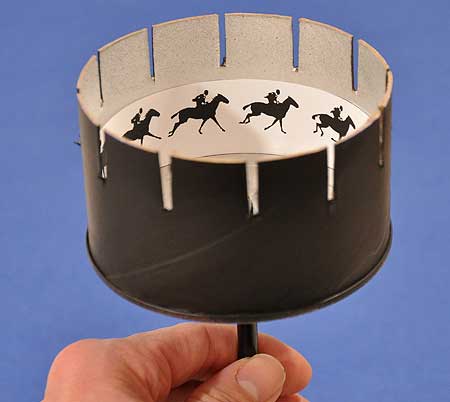
 The Zoetrope has been around since 1830's and was invented by British mathematician William George Horner. It is a mechanical optical device that allows to you see a series of images very quickly so it appears as a looped animation and was a very popular Victorian parlor toy until it was replaced by modern film technology. He named it the 'Daedalum' which translates to 'wheel of the devil' but was later renamed the 'Zoetrope' meaning 'the wheel of life'. It was created around the same idea of a device called a 'phenakistoscope' (pictured below) invented by Joseph Plateau, which requires mirrors but cannot be viewed by more than one person unlike Horner's zoetrope which multiple people can view
 
Zoetrope


Phenakistoscope


 My Version
 
I decided to make an animation of a woman flicking her hair as drawing subjects is a strength of mine and the hair could have an interesting effect when put in motion. To create this idea I videoed myself flicking my hair around in a circular motion to see how it fall and what angles my body and head made in the process. Unfortunately this video was lost but you can see how I used it to influence my final piece.
 
Through observing this and using a lightbox I created a series of drawings to be used on a strip of paper for the zoetrope. To show you how it would look i've created a GIF image below..


If I would change anything I would make the transitions between picture more precise and accurate so the whole animation would be more smooth.